If you’ve ever joined a large “sked” as a newer ham, you probably know the feeling. Callsigns are being announced one after another, someone’s giving a signal report, someone else is asking who’s next, and you’re frantically scribbling names and calls on a notepad hoping you don’t lose track of your own turn. It’s exciting — but it can also be genuinely intimidating, and for me, as a new amateur, that fear of “messing up in front of everyone” nearly kept me from checking into rounds at all.
Sked73 started as a simple observation: the hard part of a sked isn’t the radio operating, it’s the bookkeeping. You need to track who’s on, in what order, what you’ve heard about them, and what you still owe them (a signal report, a name confirmation, whatever the round calls for). Do that in your head while also trying to actually listen and transmit, and it’s no wonder rounds feel overwhelming when you’re new.
So the core idea was: let the operator just type in callsigns as they’re announced, in real time, and let the software carry the cognitive load from there.
The workflow is deliberately minimal. As each station checks in, you type their callsign into Sked73 and it’s added to the list. The software immediately looks the station up and fills in the details automatically — name, and a rough location plotted on a map — so you’re not relying on memory or a hastily scrawled note to know who you’re actually talking to.
Order matters in a round, and it doesn’t always come out clean. Maybe you mistyped, maybe two stations transmitted close together and you logged them in the wrong sequence — either way, Sked73 lets you simply reorder entries by dragging them into the right place, rather than starting over.
As the round progresses and you actually work each station, you log the signal reports both ways — what you sent and what you received — directly against that entry. At a glance, the list becomes a full record of the round: who was there, where they were, and how the exchange went, without you having to hold any of it in your head.
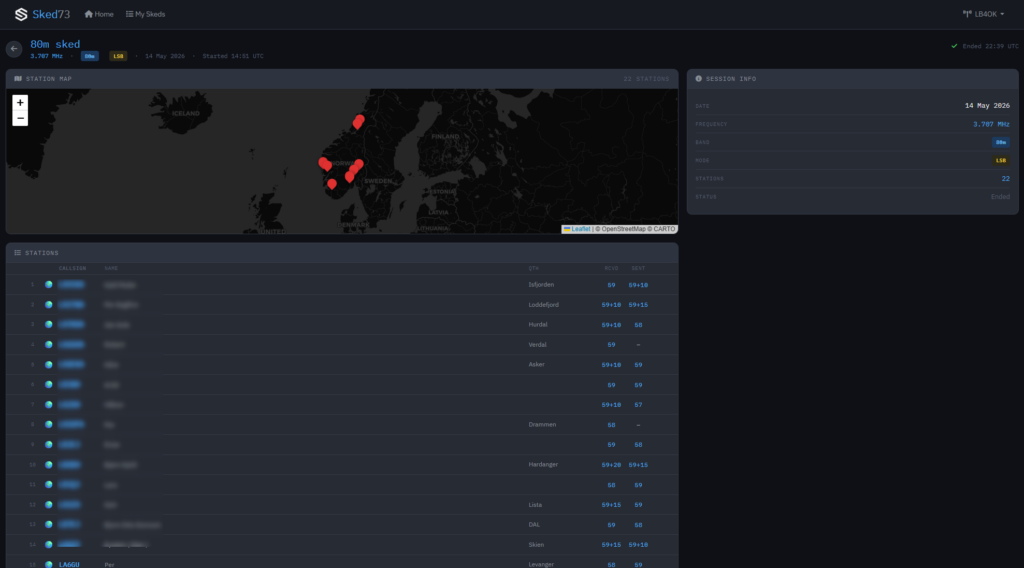
One detail I was particularly happy with is how Sked73 handles the case where a round is already registered. Rather than making every participant re-enter the same details every single time, you can simply select the existing sked. That pulls in the context automatically.
It goes a step further, too: if the sked already has stations logged that you personally missed or misheard on air, Sked73 can surface those as hints — a gentle nudge that “station X was also heard,” so a moment of static or a garbled callsign doesn’t mean that station quietly falls out of your log.
Sked73 wasn’t built to be clever for its own sake — it was built because the bookkeeping overhead of round QSOs was genuinely keeping me, and I suspect other newer operators, from participating with confidence. Lowering that barrier, even with something as unglamorous as auto-lookups and a reorderable list, turned out to make a real difference in how approachable those big, chaotic, wonderful round QSOs actually felt.
Feel free to create a user and try it for yourself, you’ll find it here: https://sked73.lb4ok.no